

Accountants as Strategic Narrators
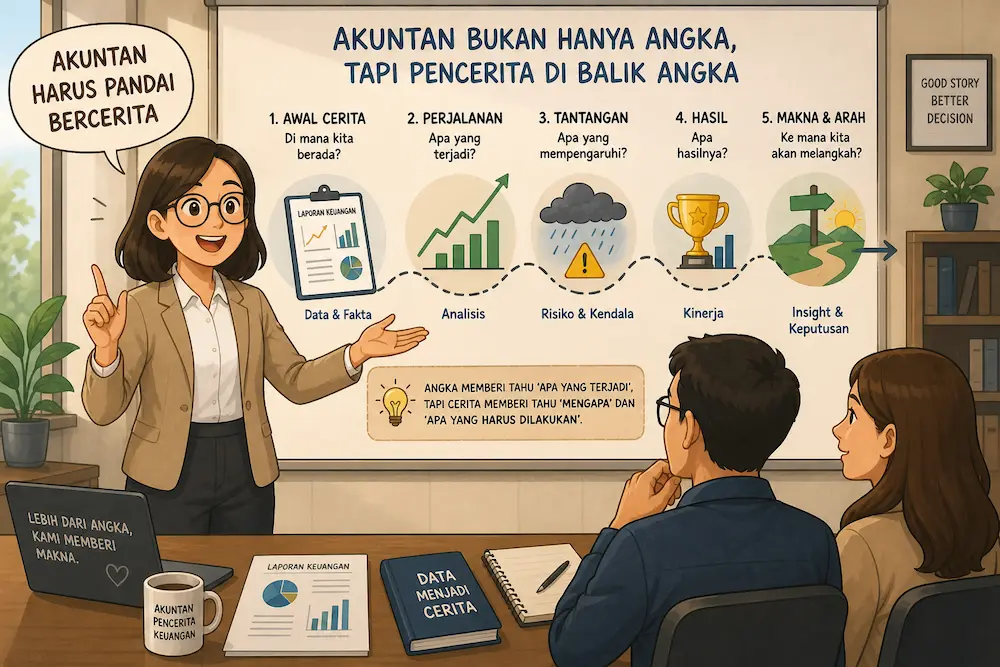
Storytelling skills are one of the seven essential skills that professional accountants must have in 2026. Artificial Intelligence gives everyone the freedom to access as much data as possible, but only humans can give meaning to the data they have.
In the accounting profession, Law No. 2 of 2024 concerning P2SK and Government Regulation No. 43 of 2025 state that accountants in the CE category have the authority to prepare financial statements for entities, where the entities accommodated by these two regulations are financial service entities, both banking and non-banking.
The support from OJK and the Stock Exchange for these two regulations requires accountants not only to prepare financial statements, but also to have the ability to communicate the message behind the written numbers. “Message first, then numbers,” said Deny Poerhadiyanto from the National Board of the Indonesian Institute of Accountants, who was appointed as one of the speakers at the event Strategic Storytelling for Accountants: Becoming a Narrator to the Strategy, held on Tuesday, April 28, through the Zoom platform.
Turning Numbers Into Stories
Those who are able to translate numbers into messages that speak to the needs of their clients will be able to reach the peak of an accountant’s career. This means that communication skills in storytelling become extremely important. These storytellers are called narrators. They deliver narratives. In fact, influence belongs only to those who are able to tell stories. The question is, how can numbers in Excel be turned into an engaging story? Naturally, the structure used for this kind of narrative is not the same as telling a fairy tale, which usually includes elements of beautifying or exaggerating.
Financial statements must be presented as they are. This means the truth must be clearly reflected. There needs to be a purpose and recommendation translated by accountants for strategic decision makers, so that the financial statements can become a benchmark for assessing the health and sustainability of the organization or institution that owns the report. Yes, it is true that it can be very overwhelming when the output received by decision makers consists of numbers spread across thousands of cells and financial tables. To make it easier to understand, we need an intelligent resolution.
There are three intersecting elements in creating an effective narrative resolution for financial statements: financial data, business context, and narrative direction. These form an intelligent resolution. This is needed to prevent message distortion. Indeed, this requires accountants to take on greater responsibility. There will be a paradigm shift, because reporting is not the same as storytelling. All numbers and complex terms in a report must be “simplified” into human language. What is the context? What are the implications? All of this needs clarity. And this requires visual language. There is no need to present all the data. Simply present the data that the audience needs.
So, who are the audiences? They include business owners, investors, directors, production employees, and many other people outside finance who may not understand the message behind the numbers. For CEOs and investors, what they need to understand is potential growth and ROI. The narrative is about how the company’s future sustainability can generate cash flow. For executive level leaders such as directors and managers, the focus is on the strategic planning needed to generate business profit in the following year. Meanwhile, for employees at the same level as accountants themselves, the focus is whether the KPIs have been achieved or not. That is what they need, because it relates to performance and remuneration. This is why an accountant who initially learned how to audit must first understand the client’s business model and business process in order to prepare an audit report that can be accounted for.
5 Steps of Storytelling Blueprint
- Extract Key Observation. Observe who the audience is.
- Structure The Narrative. Find out what happened, why it happened, and what the solution is.
- Provide Context & Analysis. Analyze the context behind why it happened and what recommendations should be given.
- Design Clear Visuals. The visual design must align with the message being delivered. Beautiful visuals without a clear message will only create confusion.
- Deliver with Impact. Create the hook, explain the implications, and present the resolution being offered.
Now, once these five written steps have been completed, the next step is how the accountant presents the report verbally. Gestures, body language, tone of voice, all of these matter, in addition to the accountant’s neat suit and appealing appearance. Physical presentation is very important. That is why accountants cannot carelessly choose clothing that represents who they are.
Beyond physical appearance, word choice is even more important. The wrong delivery can make a good message come across poorly. This is why the way a narrative is delivered must be right, the choice of words must be precise, and the information presented must be real and delivered with integrity.
Do and Dont’s Storyteller
Practice makes an expert. The more often a narrator practices, the better they become at presenting themselves. Therefore, beginners who are just starting to tell stories need to pay attention to what they should and should not do.
| ✅ DO | ❌ DON'T |
|---|---|
| Show only the most important highlights. Use BLUF (Bottom Line Up Front) to present key data. | Use financial or accounting terms that are only understood by finance people, accountants, and tax professionals. |
| Use analogies to make the message easier to understand. Simplify complex terms. | Avoid being direct, or create new questions when explaining a point without resolving that point clearly and concisely. |
| Start with a real case from the business world and explain its financial impact. | — |
RAVEN’s Commitment
The professional accountants at RAVEN continuously update themselves to become professionals who can translate complex messages and numbers from financial statements. We understand the importance of staying relevant to the needs of the times. This includes maintaining accountability through the required certifications, aligning performance and operations with changes in applicable laws and government regulations, staying updated, opening space for discussion and education with clients, and working by applying our core values.
At RAVEN, we believe that professional service is not only measured by the end result, but also by the values that shape the process. Through Resilience, Accountability, Versatility, Expercellent, and Nurturing, RAVEN stands as a strategic partner that helps businesses grow in a more focused, trusted, and sustainable way.
(Jaclyn L.)
Watch the Full Session
Connect With Us
Ready to Optimize Your Business?
Free consultation, request a proposal, or book a meeting to optimize your business's financial and operational health.
+62 817-7089-5598
Email Inquiry
KJA.Ravenconsultant@outlook.com